More and more people are choosing underfloor heating. If you're considering installing underfloor heating, it's wise to thoroughly research it. Underfloor heating offers many advantages over traditional heating, but it also has some limitations. We've outlined the pros and cons for you, so you can make an informed decision.
The benefits of underfloor heating (water-based systems)
1. More living comfort
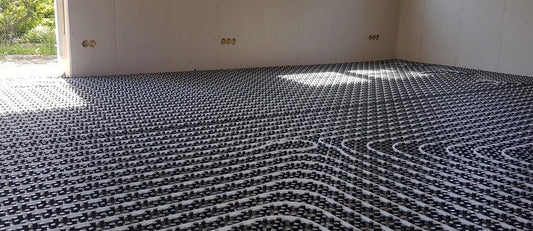
With underfloor heating, the heating pipes are distributed across the entire floor. This essentially transforms your floor into one large radiator. The large radiant surface (especially compared to a radiator) heats a room very evenly. This even heat distribution feels very pleasant and contributes positively to living comfort. And you'll never have to worry about a cold floor again.
2. Better air quality
Traditional radiator heating usually involves multiple heat sources. Because the heat radiation is concentrated at these points, air circulation occurs. Warm air rises, and cold air is drawn in. This creates circulation in the room. With underfloor heating, the entire floor is heated simultaneously. Because of the even heat distribution, there is much less air circulation, resulting in less dust in the air. Less dust in the air means better air quality.
3. Energy saving
To heat a room, the radiant heat from the heat source must spread throughout the space. Because underfloor heating has a large surface area (especially compared to traditional radiators), much less heat is needed per square meter of radiant surface. Therefore, an underfloor heating system heats at a much lower temperature than traditional heating. This means less energy is needed to reach the desired temperature in a room. This can save you up to 15% on your energy costs while enjoying greater comfort.
Underfloor heating can be connected to existing central heating systems with a central heating boiler, high-efficiency boiler*, (hybrid) heat pump, or district heating. Because of the low heating temperature, underfloor heating is also ideal for homes without a gas connection. Underfloor heating is not only good for your wallet, but also for the environment.
* High-efficiency boilers achieve optimal efficiency when the heating supply temperature (hot water) does not exceed 55° Celsius. With conventional radiators, the supply temperature is much higher, which largely negates the benefits of a high-efficiency boiler. Due to the low water temperature required for underfloor heating, combining a high-efficiency boiler with a high-efficiency boiler is optimal for optimal efficiency.
4. Space saving & child friendly
The heating pipes for underfloor heating are located under the floor. This makes underfloor heating invisible. There are no (wall) radiators, saving space. This not only makes the room more organized but also makes it easier to furnish. An added benefit is that it's also more child-friendly. A child can't burn or hurt themselves on a hard, sometimes sharp, hot radiator.
The disadvantages of underfloor heating
1. Limitation in floor finishing
A room is heated by radiant heat. With underfloor heating, the heating pipes are located in the floor (or screed). To optimally distribute heat from the floor to the room, there are limitations to the choice of floor covering. The better the floor covering conducts heat, the more efficiently the underfloor heating works. For example, there are requirements for the use of laminate or wood flooring.
2. Warm-up time
Underfloor heating is a different way to heat than traditional radiators. With underfloor heating, you essentially transform the entire floor into one large radiator. Because this happens at a low temperature, it takes a while for the floor to warm up and start emitting radiant heat. If you have an irregular schedule and only turn on the heating when you get home, it will take a while for a room to become comfortably warm.
3. Purchase costs
Installing underfloor heating takes more time and materials than installing traditional heating. This makes it more expensive to install than traditional heating. Because underfloor heating is more efficient and energy-efficient than traditional heating, you'll recoup the price difference within a few years.