Thinking of using underfloor heating with a tiled floor? It's an excellent combination! Tiles naturally conduct heat well, minimizing heat loss. Of course, there are a few things to keep in mind with tiled floors, too. We'd be happy to tell you more.
Underfloor heating under a tiled floor
Most tiles naturally conduct heat well. Ceramic tiles and natural stone generally offer the best properties for use with underfloor heating. Unlike other materials, they don't block heat but transmit it effectively. This is a significant advantage because it requires less energy to heat a room, a benefit you'll immediately see reflected in your energy bill.
What you should take into account
As mentioned, underfloor heating and tiled flooring combine well. However, there are a few things to keep in mind when installing the tiled flooring. Use a flexible tile adhesive and flexible grout. The tiles will "move" slightly as they heat up and cool down. Using flexible adhesive and grout can help to absorb the floor's movement.
After laying the tiled floor, we recommend waiting six weeks before turning on the underfloor heating for the first time. Gradually increase the temperature. This gives the tile adhesive enough time to cure properly and prevents it from delaminating, resulting in loose tiles. Never set the hot water supply temperature higher than 40° Celsius.
The installation of your underfloor heating
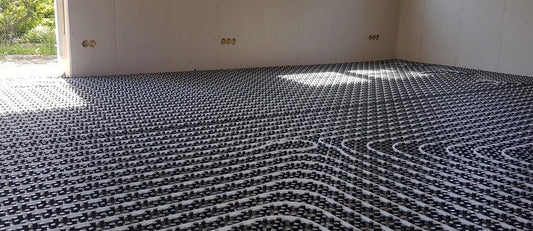
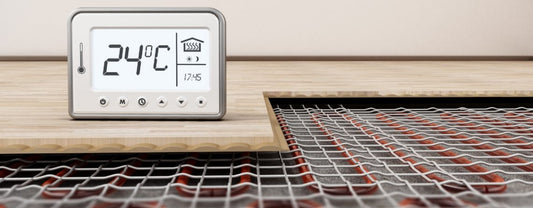
If you choose a tiled floor as a finish, you have two options for installing underfloor heating. You can install the underfloor heating in the screed by milling grooves, or you can install it on the screed using shrink mesh.
Underfloor heating in the screed floor
These days, it's almost always possible to install underfloor heating in the screed. In new construction, you install the underfloor heating first, followed by the (cement) screed. In existing buildings, it's often possible to mill the underfloor heating into the existing screed. The heating pipes are then laid in the milled grooves, after which the floor is refinished. A major advantage of underfloor heating in the screed is that no space is wasted. The finished floor can be laid directly on top of the screed.
Underfloor heating on the screed floor
When choosing a tiled floor, you can also install underfloor heating on the screed using shrink mesh. This involves laying the shrink mesh, along with the heating pipes, on the existing floor, followed by a new (cement) screed. The new screed is approximately seven centimeters high. The downside of this is that it raises the existing floor. However, there must be sufficient space for this.
Main heating or additional heating
Underfloor heating combined with a tiled floor is an excellent primary heating system. In that case, no other heat sources are needed in the room. Tiles have a very low thermal resistance (RC value), meaning virtually no heat is lost through the floor. An additional advantage is that tiles retain heat well, ensuring long-lasting and even heat distribution.
Of course, you can also choose underfloor heating as supplementary heating. Besides the heated floor, there's another heat source, such as a radiator. Either way, with underfloor heating combined with a tiled floor, you'll never have cold feet again.
The pros and cons in a row
Advantages
- Good heat conduction
- Tiles retain heat well
- Energy savings up to 20%
- Easy to clean
- Cools in the summer
Disadvantages
- Tiles can be slippery
- Joints can get dirty (tip: choose dark joints)
- Cheap tiles can have a 'cold' look