Choosing the right type of underfloor heating manifold is an important decision. There are two types of manifolds: a open distributor and a closed distributor. Both have their own advantages and disadvantages, so it's important to understand the differences. How else can you decide which manifold best suits your needs? Read more about the advantages and disadvantages of each type of manifold here, and we'll help you make the best choice for your underfloor heating!
What is an underfloor heating manifold?
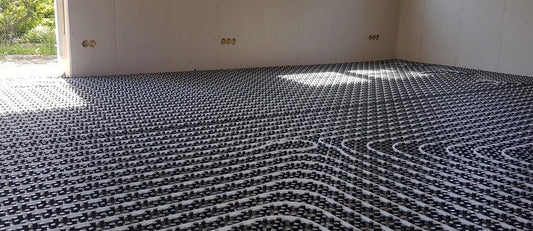
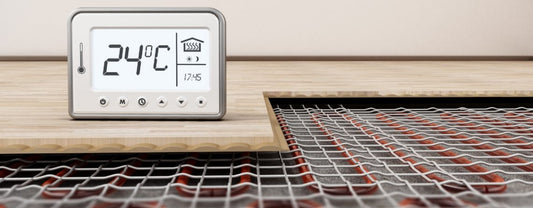
To start, it's helpful to know what an underfloor heating manifold is. A manifold ensures that the water in the underfloor heating system is evenly distributed across all the underfloor heating pipes. It's an essential component of underfloor heating. The manifold ensures that the water is distributed evenly across all the pipes. constant temperature through the heating pipes can flow. This ensures minimal temperature differences in your underfloor heating and makes it return is high.
Open distributor
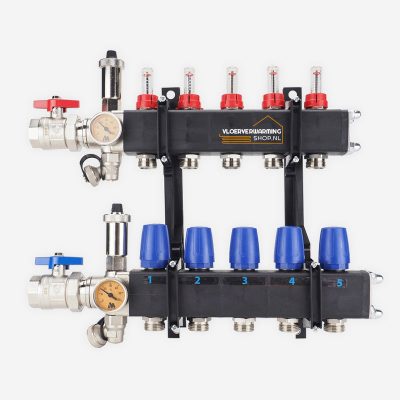
An open distributor is a distributor without pump . This transports the hot water from the heat source directly to the underfloor heating circuits. A pump mixes hot water with cold water to determine the correct temperature. A low loss header does not have a pump. Therefore, it is extra important that the heat source the wanted temperature releases water. This temperature also depends on the floor's finish.
Do you have a Heat pump ? Then an open header is a good choice for you. This heat pump often has its own pump that pumps the water through the pipe system at the correct temperature.
An open distributor can be used for a low temperature system ( LT system ). In a LT system The flow temperature is between 30°C and 45°C. This is because an open header has no temperature controller.
How does an open distributor work?
With a low loss header, there's no pump in the header. Instead, the water pump heats the water to the desired temperature, around 30°C. From the heat pump, the water flows to the header and then into the heating pipes. When the water cools, the water pump receives a signal, which then heats the water, bringing the underfloor heating back to a more comfortable temperature.
Open distributor with pump controller
As mentioned earlier, a low loss header doesn't have a pump. Without a pump, the water continues to circulate, which wastes a lot of unnecessary energy and makes the system less efficient. To prevent this, you can opt for a pump controller. pump controller Measures the temperature. Once the desired temperature is reached, the power is reduced or the pump automatically switches off, stopping the water supply. If you want to efficiently use an open header, it's important to also add a pump controller to the system.
Closed distributor
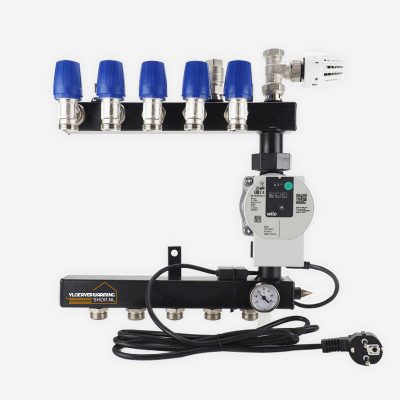
A closed manifold is a manifold with a energy efficient pump . Closed distributors are also called Mixing manifolds . The pump ensures that water can circulate for the heating pipes. The warm water from the heat source is mixed with the cold water by the manifold. The closed manifold also contains a thermostatic valve. This regulates the temperature in the underfloor heating pipes. The closed manifold ensures that the temperature in the system is neither too low nor too high. Excessive temperature can cause cracks in the floor and damage the material it is covered with (wooden, PVC, tile, etc.).
Do you have a central heating boiler, solar boiler, district heating, hybrid heat pump or Heat pump ? Then a closed manifold is the best option for you. The manifold controls the temperature for the underfloor heating, preventing the system from getting too hot. This can damage the floor, such as with PVC or wooden floors.
A closed manifold is often used for a high temperature system ( HT system ). In a HT system is the flow temperature above 45°C.
How does a closed manifold work?
Hot water flows through the underfloor heating pipes through the closed manifold, warming the floor. When the water cools, the thermostat signals, and the central heating boiler/hybrid heat pump ensures that hot water is pumped through the heating pipes again. The manifold monitors the temperature and stops the hot water supply when the temperature is correct. When the water cools again, it collects in the manifold's collection tube. Some of this water is used to maintain the flow temperature, while the rest is returned to the central heating boiler and reheated before returning to the heating pipes. As you can see, this is a very efficient system.
Conclusion
The biggest difference between a open and closed distributor is the pump. The differences are listed below:
- An open distributor has no pump and a closed distributor does have a pump
- With an open distributor, a pump switch is recommended to regulate the temperature and save energy.
- An open distributor is often used for low-temperature systems and is only suitable for a heat pump
- A closed manifold is often used for high-temperature systems and is suitable for a central heating boiler, solar boiler, district heating, hybrid heat pump or heat pump.
- A closed distributor mixes the hot water with the cold water to reach the desired temperature
- With an open distributor, the heat source ensures the correct temperature
Do you have any questions after reading this blog about which distributor is best for you? Then please contact us. contact Contact one of our underfloor heating specialists. We're happy to help. Or take a look at our web shop To order the correct open or closed manifold for your underfloor heating directly. Order before 4 PM today, and you'll have it delivered tomorrow, ready to get started!