What type of manifold do you need for your underfloor heating? And what is the difference between a low-temperature system distributor and a high temperature system distributor? And what about block and district heating? We're happy to explain it to you!
What is an underfloor heating manifold?
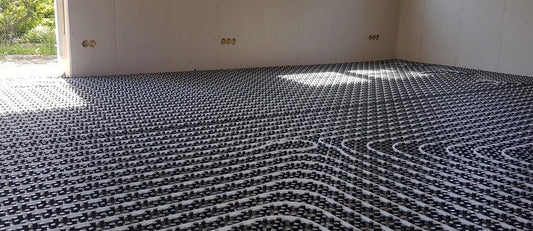
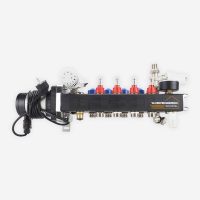
Before we start telling you which type of manifold you need, it's helpful to know what an underfloor heating manifold is. A manifold ensures that the water in the underfloor heating system is evenly distributed across all the underfloor heating pipes. The manifold ensures that the water is distributed evenly across all the pipes. constant temperature through the heating pipes is pumped. This ensures that there is a minimal temperature difference in your underfloor heating and it return high. It is an essential part of underfloor heating.
The type of manifold you need depends on the primary heat source. If you have a central heating system, the temperature of the supplied water will determine whether we are talking about a Low temperature system (LT) or High temperature system (HT) . Each system has its own type of distributor. Is the home connected to Block or district heating ? Then you need a distributor that is suitable and meets the requirements for district heating.
Low temperature system (LT system)
A low temperature system manifold is a manifold that is suitable when the supply temperature never exceeds 45˚C. The supply temperature then lies between the 35˚C and 45˚C . In a LT system, there is a central pump in the heating system, for example, in a heat pump. LT systems often have Open Manifolds ; a manifold without a pump. This is because the supply temperature doesn't need to be mixed with cold water, so it goes directly into the underfloor heating pipes.
Because homes are better insulated these days, heat is retained more effectively. A low-temperature system heats the floor more evenly and consistently. Is your house well insulated and do you have a central pump? Then choose a low temperature system distributor .
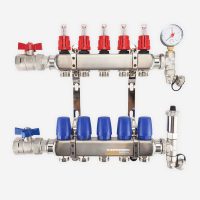
The difference between LT system and LTV system distributors
In low-temperature systems, we distinguish between two systems: the LT system and the LTV system. The difference here is the supply temperature. As mentioned earlier, the supply temperature of an LT system is between 35˚C and 45˚C . The supply temperature in an LTV system is between 40˚C and 65˚C . In addition, an LT system manifold is a manifold without a pump; a Open distributor . The LTV system distributor is a mixing distributor with pump; a Closed distributor .
With an LTV system, it's possible to mix the supply temperature with cold water, thus lowering the temperature. This isn't the case with an LT system, as the supply temperature is at a comfortable level and doesn't need to be lowered.
High temperature system (HT system)
A high temperature system manifold is a manifold that is suitable when the supply temperature is between 60˚C and 95˚C . This is often the case with a central heating boiler or hybrid heat pump. With a hybrid heat pump, the temperature is generally lower than 60˚C, but there can be variations because it is connected to the central heating boiler. Therefore, a high-temperature system is required. With a high-temperature system, the heating system is connected to a high-temperature supply. A closed-loop manifold with a pump must also be connected to the underfloor heating system. This is because the supply temperature must be mixed with cold water to reach the desired temperature.
Do you have a high supply temperature from the heating system? Then choose a high temperature system distributor to heat the floor.
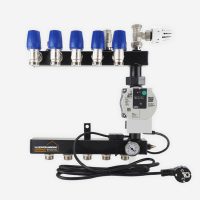
Block and District Heating Distributor
Block heating is a heating system with a collective boiler . This can heat several apartment complexes or office complexes, for example. District heating is a heating system in which several homes and buildings are heated via a underground network by hot water pipes .
If you use block or district heating, it is important to know that a special distributor is required for this. Block and district heating have a high supply temperature, requiring a distributor with a pump. This distributor then regulates the water temperature and ensures it reaches the desired temperature.
Conclusion
The biggest difference between a low-temperature manifold and a high-temperature manifold is the supply temperature you need to consider. Below is an overview of the differences.
| Type of distributor | Temperature | With or without pump | Open or closed distributor* |
| LT system distributor | Between 35˚C and 45˚C | Without pump | Open distributor |
| LTV system distributor | Between 40˚C and 65˚C | With pump | Closed distributor |
| HT system distributor | Between 60˚C and 95˚C | With pump | Closed distributor |
| Block or district heating | Between 80˚C and 90˚C | With pump | Closed distributor |
* Read the difference between a open or closed distributor.
Do you still have questions about which type of distributor you need after reading this blog? Then please contact Contact one of our underfloor heating specialists. We're happy to help. Or take a look at our web shop Order the right manifold for your underfloor heating today. Order before 4 PM today, and you'll have it tomorrow, ready to get started!